

Technology Integration in Indian Farming: Key Challenges and Solutions
- Mamta Devi
- Mar 2
- 6 min read


Written By: Jagriti Shahi

Agriculture in India is at a crossroads. While traditional practices have sustained millions for generations, the pressures of climate change, labour shortages, and market demands make technology integration not just beneficial — but essential. However, adopting modern tech on Indian farms isn’t without challenges.
High Cost of Technology
The cost of basic agricultural drones in India ranges from INR 4 lakhs to INR 15 lakhs (USD 5,000 - 20,000). For small-scale farmers with limited capital, such high costs are unaffordable (Source: Economic Times).
Infrastructure Instability: Power Supply Constraints
As of 2021, 24% of rural Indian households reported issues with inconsistent or unreliable electricity, making it difficult for farmers to use technology-dependent systems like automated irrigation or sensor-based monitoring (Source: Ministry of Power).
Challenge
One of the primary obstacles to technology integration has been irregular and fragmented electricity supply. Modern farming tools such as irrigation pumps, fertigation systems, soil testing devices, and processing units rely on stable power.
Electricity is often available only during specific time windows distributed across the day or night. This unpredictability creates operational complications:
Irrigation must be aligned with power availability rather than crop requirement.
Late-night supply demands labor presence at unconventional hours.
Equipment testing and technology trials face interruptions.
Automated irrigation systems lose efficiency due to manual dependency.
Planning becomes reactive rather than strategic.
Technology becomes less effective when foundational infrastructure is unstable.
Solution
To address this, several practical approaches were identified:
Solar-powered backup systems to ensure daytime irrigation independence.
Water storage planning, where water is pumped during supply windows and stored for controlled release later.
Smart timers and controllers that automatically activate during power availability.
Load prioritization, focusing electricity use on critical operations first.
Hybrid energy models, combining grid supply with solar or generator backup.
The key learning is that technology integration must include energy planning, not just digital tools.
Traditional Practices
More than 60% of Indian farmers still rely on age-old farming techniques, which often conflict with the modern technologies being introduced. The challenge is to balance traditional knowledge with technology to improve productivity (Source: India Rural Development Report 2018).
Training and Extension Services
According to a 2019 NITI Aayog report, only 32% of Indian farmers have access to any form of agricultural extension services, which are critical for training and educating farmers about new technologies.
Water Usage
Agriculture accounts for over 80% of India's freshwater usage. However, only 5% of Indian farmers use modern irrigation systems like drip or sprinkler irrigation, which are more efficient than traditional flood irrigation methods (Source: World Bank, Ministry of Agriculture).
Internet Access in Rural India

The gradual increase in rural internet penetration is a positive indicator of digital connectivity reaching underserved areas. Despite this progress, rural internet usage still lags behind urban areas by nearly 30%, highlighting a critical barrier to adopting digital agricultural technologies such as mobile apps for farming advice or precision agriculture. Bridging this gap is essential to ensure equitable access to agricultural innovations in India.
Farm Sizes in India
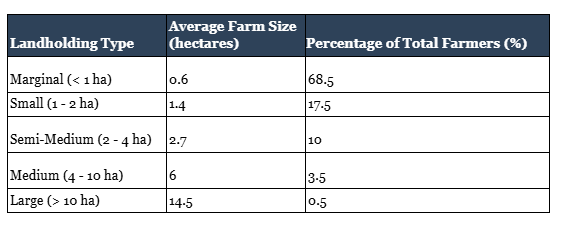
Marginal and small farmers make up over 85% of the farming community in India, with most cultivating less than 2 hectares of land. These small farm sizes present challenges in adopting expensive modern agricultural technologies, such as precision farming tools and drones, which are often costly and require larger fields to be effective. Economies of scale are limited in small farms, making it harder for these farmers to invest in advanced technologies without financial support.
Adoption of Agricultural Technology

The adoption of advanced agricultural technologies in India remains low, with fewer than 6% of farmers using automated irrigation systems and less than 2% utilizing precision farming tools or drones. This low adoption rate underscores the barriers farmers face, such as high upfront costs, lack of technical knowledge, and limited access to financing. However, a relatively higher percentage of farmers (15.6%) are using mobile apps for advice, indicating a potential entry point for further technological interventions.
Post-Harvest Losses in India by Commodity

Post-harvest losses are a major challenge in Indian agriculture, particularly for fruits and vegetables, where almost 16% of produce is lost after harvest. These losses contribute significantly to food insecurity and waste. Technologies that enhance storage, processing, and logistics are critical to reducing these losses and improving the income of farmers. Investments in cold chain infrastructure and innovations like smart packaging could help address this issue.
Financial Inclusion in Rural India

Despite gradual improvements in financial inclusion, with over half of farmers now having access to institutional credit, a large number still rely on informal sources like moneylenders, which often come with high interest rates. Access to affordable credit is a critical factor in enabling farmers to adopt new technologies, buy better equipment, and improve productivity. Digital financial services and government-backed credit schemes have helped improve this access, but further efforts are needed.
Mobile Phone Ownership in Rural India - 2023

The increasing penetration of mobile phones in rural India is a significant enabler for digital transformation in agriculture. With nearly 94% of rural households having access to mobile phones, there is immense potential for the widespread use of mobile-based agricultural services. Apps providing weather updates, farming advice, and market prices could greatly benefit rural farmers, helping them make informed decisions and improve their productivity.

Labor Costs in Indian Agriculture
Labor costs for activities like manual irrigation and harvesting continue to rise, with daily wages ranging from INR 300 to 600 depending on the region and type of work. Mechanization, such as using automated irrigation systems or drones for crop monitoring, could reduce dependency on manual labor and increase operational efficiency, but these technologies must become more affordable for small-scale farmers.
Costs of Key Agricultural Technologies in India (2024)

While high-end agricultural technologies such as automated irrigation systems or agricultural drones come at a higher cost (up to INR 2,00,000 for basic drones), smaller technologies like soil moisture sensors are relatively affordable, costing around INR 1,500-5,000 per unit. The upfront investment for large systems, however, is still prohibitive for small farmers, especially without subsidies or financial assistance.

The cost of building agricultural infrastructure such as cold storage facilities or warehousing is substantial but more affordable for small-scale operations, particularly with government subsidies. For instance, a small cold storage unit for fruits and vegetables can range between INR 8 to 20 lakhs, which is feasible for larger cooperatives but still expensive for individual farmers. Improving access to micro-loans or subsidized schemes can make these technologies more attainable.
Several key developments have emerged in the context of introducing technology into Indian agriculture:
Digital Literacy Initiatives: The Pradhan Mantri Gramin Digital Saksharta Abhiyan (PMGDISHA) has significantly advanced digital literacy in rural India. By March 31, 2024, approximately 6.39 crore (63.9 million) rural residents were trained under this scheme, surpassing the initial target of 6 crore. Notably, Uttar Pradesh led with 1.45 crore beneficiaries, followed by Bihar with 74.12 lakh. government.economictimes.indiatimes.com
Small and Marginal Farmers: India's agricultural landscape remains predominantly composed of small and marginal farmers. A survey conducted by the National Sample Survey Office (NSSO) between July 2022 and June 2023 revealed that among individuals aged 15-24 years, approximately 78.4% possessed the skills to send messages, emails, and attachments. Additionally, about 94.2% of rural households and 97.1% of urban households owned telephones and/or mobile phones. telecom.economictimes.indiatimes.com
Financial Challenges: The agricultural sector continues to face financial hurdles. In July 2024, reports indicated that top private lenders in India were experiencing an increase in farm loan defaults. Farmers and rural borrowers struggled with delayed repayments due to unpredictable weather conditions and rising agricultural input costs. The largest five private banks reported higher bad loan additions in the June quarter, notably in agriculture and microfinance loans. reuters.com
Climate Resilience and Technological Adoption: Climate change poses significant challenges to Indian agriculture. In Rayanpet village, farmers have faced unpredictable rains and increasing heat, jeopardizing their rice crops. To address these issues, agricultural research organizations have developed climate-resilient rice varieties that yield more with less water and offer higher disease resistance. Over the past decade, more than 2,000 resilient seed varieties have been released, with plans to cover 25% of paddy fields with these seeds in the upcoming winter season. apnews.com
Key Lessons
An important principle emerges: technology integration in Indian farming is not simply about installing advanced tools—it is about creating a supportive ecosystem.
Successful integration requires:
Reliable infrastructure or alternative energy planning.
Farmer education and trust-building.
Financially phased implementation.
Local customization.
Conclusion
Technology has the potential to transform Indian agriculture by improving productivity, resource efficiency, and sustainability. However, successful integration must be practical, adaptive, and aligned with ground-level infrastructure realities.
The future of Indian farming lies not only in smart technologies—but in smart systems designed around real rural conditions.
Global Launch Base helps international startups expand in India. Our services include market research, validation through surveys, developing a network, building partnerships, fundraising and strategy revenue growth. Get in touch to learn more about us.
"AI-Generated Content Disclaimer: This content was generated in part with the assistance of artificial intelligence tools. While efforts have been made to review, edit, and ensure accuracy, completeness, and reliability, the content may contain errors or omissions. It should not be considered professional advice, and users should independently verify any information before making decisions based on it. The publisher/author assumes no responsibility or liability for any consequences resulting from reliance on this content."


Comments