

.png)
Rural Energy Cooperatives: Community-Led Solar and Bioenergy Startups
- Mamta Devi
- Jun 23, 2025
- 4 min read


Written By: Jagriti Shahi
In a country where over two-thirds of the population resides in rural areas, energy access isn't just a utility—it's a lifeline. While India has made significant strides in electrification, many villages still experience inconsistent supply, high costs, and limited access to clean fuel for cooking and irrigation. Amid these challenges, Rural Energy Cooperatives—powered by solar and bioenergy startups—are emerging as a transformative, community-led solution for inclusive energy transition.

What Are Rural Energy Cooperatives?
A Rural Energy Cooperative is a democratically managed, member-owned organization that generates and distributes energy—often renewable—to its members. These cooperatives enable rural communities to take control of their energy needs, finances, and future. Unlike top-down infrastructure deployment, this model promotes bottom-up innovation, accountability, and local ownership.
Key Features:
Member-owned and managed
Collective decision-making
Profit reinvested or distributed among members
Strong emphasis on social and environmental impact
Solar Startups Empowering Villages

Applications:
Microgrids: Solar-powered grids for entire hamlets
Rooftop Solar: Shared installations on schools, health centers, and homes
Solar-Powered Tools: Water pumps, grinders, threshers, and refrigeration units
Notable Projects:
Oorja in Uttar Pradesh runs solar microgrids that provide affordable power for lighting, irrigation, and small businesses.
Selco Solar offers decentralized energy services to power sewing machines, rice hullers, and classrooms in Karnataka.
Mera Gao Power installs ultra-low-cost solar microgrids in remote Uttar Pradesh villages for lighting and mobile charging.
Bioenergy Cooperatives: From Waste to Wealth
Types of Bioenergy Models:
Family-sized biogas plants using cattle dung
Community biogas digesters powered by organic waste
Agro-waste biomass briquettes used for rural industries
Key Benefits:
Clean cooking fuel replaces wood, dung cakes, and LPG
Digestate from biogas plants used as organic manure
Income through carbon credits and surplus power sale
Case Examples: Rural Energy Cooperatives in Action
1. Dharnai, Bihar – India's First Energy-Independent Village
Technology: 100 kW solar microgrid powering over 400 homes, streetlights, irrigation, and small shops.
Led by: Greenpeace India in partnership with BASIX and local community leaders.
Impact:
2. Pani Panchayat Biogas Project, Maharashtra
Technology: Centralized biogas plant using sugarcane press mud and cow dung.
Led by: A cooperative of sugarcane farmers in a drought-prone area.
Impact:
3. Oorja Development Solutions, Uttar Pradesh
Technology: Solar microgrids and pay-per-use solar irrigation systems.
Led by: Social enterprise working with local farming cooperatives.
Impact:
4. SELCO Foundation – Livelihoods through Energy, Karnataka
Technology: Solar-powered sewing machines, rice mills, weaving units, cold storage.
Led by: SELCO Foundation with rural cooperatives and SHGs.
Impact:
5. Smart Power India (SPI) Microgrids – Uttar Pradesh, Bihar, Jharkhand
Technology: Solar-biomass hybrid mini-grids (10–50 kW capacity).
Led by: Rockefeller Foundation and Tata Power.
Impact:
6. Husk Power Systems – Bihar & Uttar Pradesh
Technology: Hybrid power plants (solar + biomass) with smart metering.
Led by: Tech-driven startup in partnership with local cooperatives.
Impact:
7. Gram Oorja – Maharashtra & Karnataka
Technology: Community solar microgrids for tribal villages, often combined with biogas for cooking.
Led by: Gram Oorja Solutions in partnership with Tata Trusts.
Impact:
8. Bangladesh Rural Electrification Board (Global Example)
Technology: Over 80 rural electric cooperatives using solar home systems.
Led by: Government-supported but community-managed model.
Impact:
9. Biogas Community Model – Khunti, Jharkhand
Technology: Centralized biogas units for multiple tribal households.
Led by: Tribal women's cooperative in collaboration with PRADAN.
Impact:
10. Punjab Energy Development Agency (PEDA) – Biomass Energy Cooperatives
Technology: Paddy straw and sugarcane trash used to run biomass power plants.
Led by: Farmers' cooperatives with facilitation by PEDA and PSPCL.
Impact:
Technology & Innovation Enablers

Business Models Driving Sustainability
Pay-As-You-Go (PAYG): Affordable monthly fees for power access, no upfront cost.
Rent-to-Own: Equipment ownership transferred after a period of installment payments.
Service Contracts: Cooperatives pay service providers to manage operations.
Co-Funding: Villagers contribute small capital and labor, NGOs and startups provide tech and training.
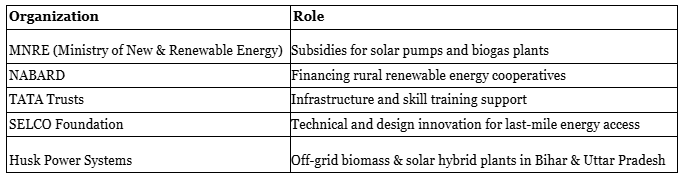
Key Partners & Enablers
Impact Snapshot

Challenges to Overcome
High Capital Costs: Upfront investment needed for panels, batteries, or biogas digesters
Maintenance & Technical Support: Local capacity building is critical
Policy Hurdles: Licensing for grid-connected systems and feed-in tariffs can be restrictive
Community Buy-In: Initial skepticism and behavioral inertia
The Way Forward
To unlock the full potential of rural energy cooperatives, India needs:
Cluster-based Models for scale efficiency
Digital Energy Platforms for cooperative management
Youth Engagement in rural tech and entrepreneurship
Green Credit Integration to monetize ecosystem services
Regional Innovation Hubs focused on renewable energy and agritech
Conclusion
The intersection of renewable energy, local governance, and social entrepreneurship is the foundation of the rural energy revolution. Community-led solar and bioenergy cooperatives are not just lighting homes—they are illuminating new possibilities for self-reliance, climate resilience, and rural prosperity.
As more startups, impact investors, and cooperatives collaborate, the vision of energy-empowered villages can become the norm, not the exception.
About Global Launch Base:
Global Launch Base helps international startups expand in India. Our services include market research, validation through surveys, developing a network, building partnerships, fundraising and strategy revenue growth. Get in touch to learn more about us.


Comments