

Agricultural Rental Solutions for Small Farm Challenges
- Mamta Devi
- Jul 15, 2025
- 7 min read


Written By: Jagriti Shahi '
In India, where the average farm holding is just 1.08 hectares (around 2.67 acres), farmers often face serious limitations in accessing high-end agricultural equipment. Unlike in countries with large-scale commercial farms, Indian farmers cannot justify the cost of owning expensive machinery like combine harvesters, which typically require 200 to 500 acres of continuous land to be economically viable.
This poses a significant barrier to achieving economies of scale—a vital component of making agriculture more efficient and profitable.

The Barriers to Mechanization for Small Farmers
Small landholders face a confluence of structural and economic challenges that hinder their ability to mechanize. Chief among these is the cost of ownership. A new tractor, for example, can cost upwards of ₹6–10 lakh in India, while combine harvesters and other specialized machinery may cost even more. Such capital-intensive investments make little economic sense for a farmer who may only use such equipment for a few days each year.
Additionally, land fragmentation further complicates matters. In many regions, farmland has been subdivided over generations, resulting in plots that are narrow, non-contiguous, and difficult to navigate with large machinery. This not only reduces operational efficiency but also limits the viability of large-scale mechanization.
There are also intangible barriers—such as lack of training, low digital literacy, and fear of equipment damage—which discourage farmers from adopting even rental-based solutions. In many cases, there is simply no awareness that such services exist or that they could be affordable.
Shared Equipment: A Practical and Scalable Alternative
The concept of sharing agricultural equipment is not new, but its modern implementation—especially with the help of digital platforms and cooperative frameworks—has made it a scalable solution for smallholders. Shared equipment models operate on the principle that farmers do not need to own machines to benefit from them; instead, they can rent what they need, when they need it, at a fraction of the cost.
One of the most prominent developments in this space is the growth of Custom Hiring Centers (CHCs). These centers, often supported by government schemes, act as local hubs that maintain a fleet of agricultural machines and rent them to farmers on a need-basis. These CHCs typically charge on a per-hour or per-acre basis, and offer a range of equipment including tractors, power tillers, paddy transplanters, harvesters, and even irrigation systems.
In India, the Ministry of Agriculture has actively promoted such centers through the Sub-Mission on Agricultural Mechanization (SMAM), leading to the establishment of thousands of CHCs across the country. The impact has been particularly visible in states like Punjab and Tamil Nadu, where smallholders have reported improved yields and reduced labor costs as a result of timely mechanization.
The Rise of Farm Equipment Rentals

Historically, India didn’t have a widespread culture of mechanized farming. But with rising labor costs, shrinking land holdings, and the need for timely operations during short harvest windows, farmers are increasingly turning to equipment rental solutions.
This shift has given rise to what some call the "Uber/Ola model of farming"—a shared economy where tractors, tillers, sprayers, and even harvesters can be rented as needed. This model enables smallholders with even half an acre to access machinery that was previously out of reach.
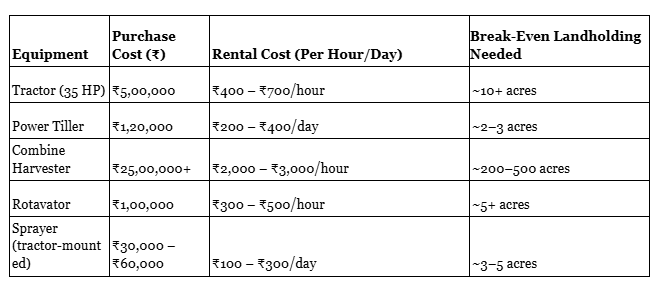
Example:
A farmer with just 0.5 acres of land might need to harvest quickly to avoid losses from unseasonal rain. Owning a combine harvester is out of the question—but renting one for a few hours solves the problem, increasing productivity without upfront capital investment.
Digital Platforms and AgriTech Innovation
In parallel, the rise of AgriTech startups has created new digital channels for renting equipment. Companies such as Trringo, EM3 Agri Services, and Gold Farm have developed platforms that allow farmers to book machinery through mobile apps or call centers. These platforms function similarly to ride-hailing services, connecting machine owners with those in need, and often handling logistics, payments, and service quality control.
Trringo, for example, operates on a franchise model and partners with rural entrepreneurs who own tractors and other machinery. Through its digital system, farmers can request services in their local language, and receive the equipment at their farm within a few hours. EM3 Agri Services takes this one step further by offering “farming as a service,” where they provide not just machinery, but complete farm operations—from land preparation to harvesting—on a turnkey basis.
These platforms are particularly significant in regions where traditional CHCs are either absent or inefficient. Moreover, by introducing real-time booking, price transparency, and service ratings, they bring a level of trust and convenience that was previously missing in informal rental arrangements.
The Role of FPOs and Cooperatives in Equipment Access
Farmer Producer Organizations (FPOs) have also emerged as crucial players in enabling collective access to farm equipment. By pooling financial and operational resources, these cooperatives are able to purchase and maintain machinery for the benefit of all members. Unlike commercial rental models, FPOs tend to offer subsidized or at-cost services, ensuring even the poorest members can benefit.
In many cases, FPOs also train operators, manage scheduling, and ensure that machines are maintained and available throughout the season. This creates a sustainable ecosystem where ownership remains collective, but access remains equitable. Moreover, many state and central government schemes now prioritize FPOs for subsidies and low-interest loans, recognizing their role in bridging the mechanization gap.
Local Entrepreneurship and Private Rentals
Another emerging trend is the growth of rural entrepreneurs who invest in agricultural machinery and offer it for rent within their communities. These individuals often act as informal CHCs, charging per-use fees and providing essential equipment to those who cannot afford to own it. With the help of government-backed microfinance and equipment subsidies, such entrepreneurship is becoming increasingly viable.
These entrepreneurs not only facilitate equipment access but also create local employment. They often hire drivers, mechanics, and field coordinators—thus generating economic activity beyond just farming. In many cases, they also collaborate with AgriTech platforms, extending the reach of digital services into deeper rural areas.
Measurable Impacts of Rental and Shared Models
Research and field data show that rental-based access to farm machinery results in a range of tangible benefits for smallholders. Firstly, cost savings are significant. Renting a tractor for tilling, for example, costs only a fraction of what it would cost to own and maintain one over time. Secondly, timely access to equipment improves the efficiency and quality of farming operations. Crops can be sown and harvested on time, reducing yield losses due to weather or labor unavailability.
Furthermore, mechanized operations such as laser land leveling, mechanical harvesting, and precision seeding have been linked to improved water-use efficiency and higher crop yields. These practices are now becoming accessible to smallholders only because of the availability of rental models.
Importantly, shared equipment models also reduce the carbon footprint of agriculture. By maximizing the usage of each piece of machinery—rather than letting it sit idle on individual farms—these models reduce resource waste, emissions, and overall energy consumption.
Government Support and Policy Frameworks
Governments have a vital role to play in promoting shared equipment systems. In India, multiple policy interventions have been made to support this transformation. Apart from SMAM, schemes such as the Agri Infrastructure Fund and Rashtriya Krishi Vikas Yojana (RKVY) provide funding and incentives for setting up equipment hubs, especially through FPOs and agri-entrepreneurs.
There are also targeted schemes for promoting drone usage in agriculture, wherein farmer collectives and startups can receive subsidies of up to 100% on drone procurement and training. These initiatives are expanding the horizon of mechanization beyond traditional tools, into areas like precision spraying, crop mapping, and input optimization.
The Problem: Inefficiency in the Current Rental Model
Despite its promise, the current equipment rental ecosystem in India is highly fragmented and inefficient. Key issues include:
Lack of real-time availability tracking
Poor logistics coordination
Limited standardization of pricing
Minimal digital penetration in rural markets
Difficulty in ensuring equipment quality and service
These inefficiencies often lead to delays, increased costs, and frustration for smallholders—undermining the very purpose of shared resources.
How to Fix It: Building Efficient Rental Ecosystems
To make the rental economy truly transformative, several interventions are needed:
1. Digital Platforms with GPS-Enabled Tracking
Just as Uber shows you where your cab is, platforms for agricultural equipment should allow real-time tracking of machine availability and movement. Companies like Trringo (Mahindra Group) and EM3 Agri Services have made progress, but scale and penetration are still lacking.
2. Village-Level Common Service Centers
Creating custom hiring centers (CHCs)—clusters where farmers can access shared tools and staff to operate them—can improve efficiency. These could be run by cooperatives, FPOs, or agri-startups, enabling micro-rentals and easier access.
3. Dynamic Pricing and Subscription Models
Offer tiered packages or subscriptions for smallholders—daily, seasonal, or per-use rentals. Bundling services (equipment + operator + fuel) could also simplify decision-making for farmers.
Looking Ahead: The Future of Equipment Access
The future of farm mechanization lies not in universal ownership, but in intelligent access. Emerging technologies such as AI, machine learning, and IoT can make shared equipment models even more efficient. Predictive analytics can be used to schedule equipment allocation, while remote monitoring can reduce breakdowns and ensure machine health.
Additionally, the use of solar-powered and electric machinery is gaining traction, especially for small-scale tasks like irrigation and spraying. Drone-as-a-service models, which provide per-acre pricing for aerial spraying or imaging, are also expanding rapidly.
Ultimately, the goal is to make farming more efficient, resilient, and profitable—regardless of the size of the landholding.
Conclusion
While India's small and fragmented farms pose challenges, they also open up opportunities for innovation. By investing in efficient, tech-enabled rental systems, we can unlock the true potential of smallholder agriculture. It's not about owning more land—but accessing the right tools at the right time.
That’s how the next wave of rural transformation will take shape—not through expansion, but through collaboration and shared access.


Comments